Posts

Passengers the Movie : Space Journey to Another Planet

Image
On Christmas day, I watched a movie that I really like. The movie was titled Passengers. It was a drama science fiction movie about a journey of a spacecraft called Avalon to an Earth-like planet named Homestead 2. Since the trip took 120 years, all the 5000 people aboard must be put into cryonic sleep. The sleeping pod would awaken automatically just before they arrived in destination planet. The idea is mind blowing and I wouldn’t mind to be involved in such a quest. But at thirty years, a giant asteroid crashed and destroyed the spaceship’s bow shock. Most of the equipment has been auto repaired but one cryonics capsule is still malfunctioned and the person inside awoke. At first he was confused because nobody else was awake. A robot introduced him everywhere. Then he went into the planetarium. He asked the computer: “where is homestead 2?” the computer replied:  “90 light years away” it was then he realized that he woke up too early! He lived alone for 1 year a...
Make Friends with Gravity

Image
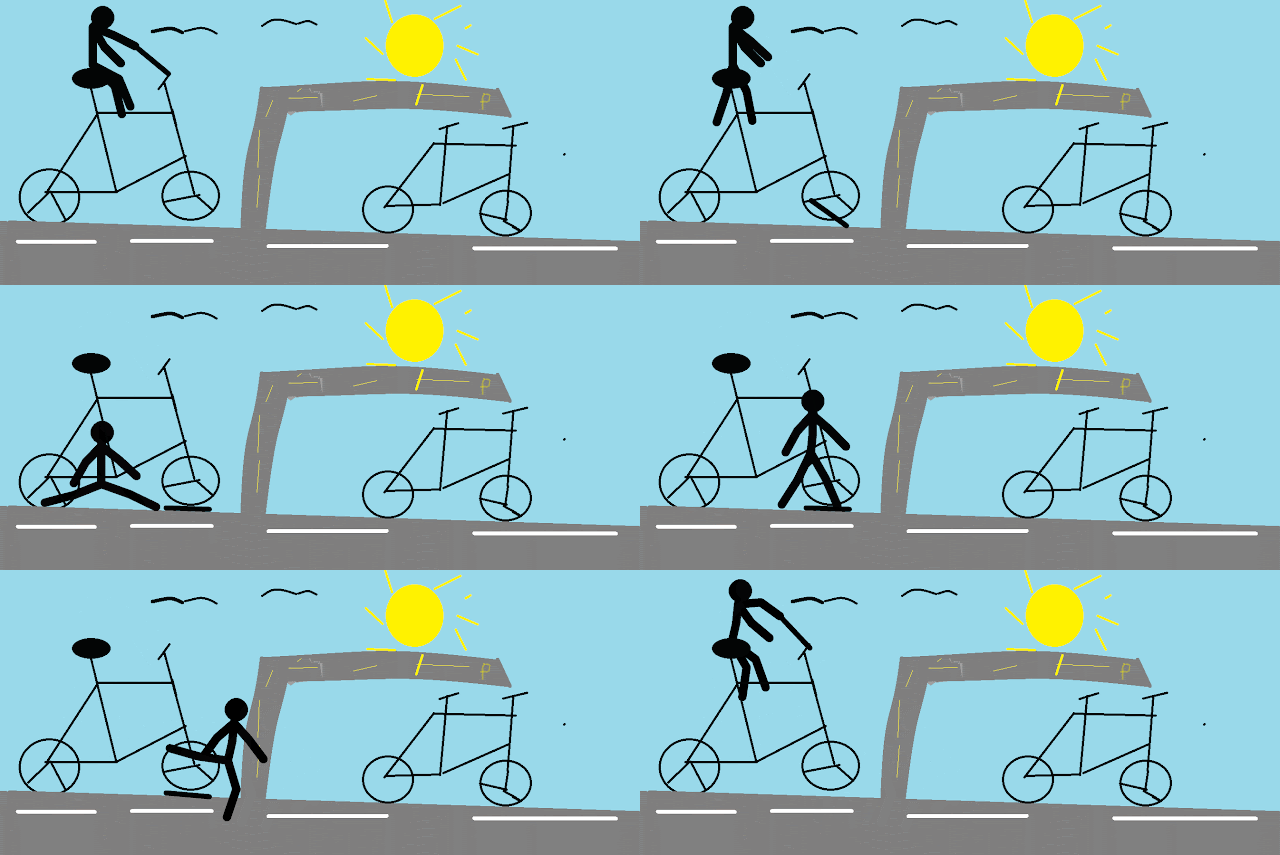
This cyclist must make better friends with gravity. 9.8 meters per second is the speed of gravity. And that is also the speed that you don't like when falling from a bicycle. Of course, you don't want to try. So DON'T. And don't do anything daredevil like in the animation below.

Adhesion and Cohesion

Image
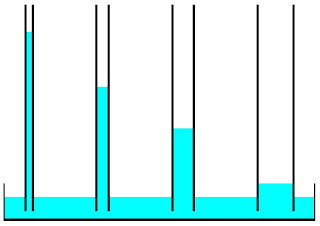
If you haven’t, read my “Hydrogen bonds” blog first if possible. Like I said, this time we are going adhesion and cohesion. Let’s start with adhesion. Adhesion are 2 materials (example: water and glass) that have different polarities and can stick to each other. One interesting thing about adhesion is the capillary action that makes water climb up a glass tube. Now you need to imagine. Imagine that you have a plastic tub. Then you have a very thin glass rod, about 3 mm thick, and it’s hollow. You put the glass rod in the tub, and something interesting happens. The water will climb up the glass tube. It climbs up the glass tube because it’s more attracted to the glass than to itself. This is also adhesion because it is attracted to each other. They are attracted because water has a polarity and glass also has one. Adhesion happens because there are polarities in some atoms, like water and glass. A positive atom will stick to a negative atom. Same goes for cohesion. But, cohe...

My 1st animation, funny

Image
Don't drive daredevil!

Hydrogen Bonds in Water

Image
I think this isn’t a secret to anyone, but water is essential to life as we know it. When you think of your cells, they have chemical processes that include water, and happen in water. Now it’s a little strange. What gives water all these unique properties? Water, as you probably already know, is made of 2 hydrogen atoms and 1 oxygen atom. That’s why we call it H2O. The bonds between the atoms are called covalent bonds. The good thing about water is that oxygen is extremely electronegative. If you don’t know, electronegative means that the element likes to keep electrons for itself. To be precise, it hogs electrons. Because the electrons keep going around the oxygen, the hydrogen atoms have a positive charge. When you put two water molecules together, they are kind of nice. Oxygen has a positive charge and hydrogen has a negative charge. When you put them together, they will stick. That will form a hydrogen bond. Hydrogen bonds are the reason why water has this fluid, nice...

What is Aurora?

Image
Auroras are the spectacular dancing lights that mostly happen around the poles. Surprisingly, they are caused by the sun’s solar rays. Probably you already know the magnetosphere that protects us from the sun’s harmful rays. There are cracks in the magnetic fields on the poles that produce auroras.  But how do the auroras get their color? Air is made of nitrogen (79%) and oxygen (20%). Oxygen glows yellow-green when hit low in the atmosphere and orange higher up. Nitrogen glows bright red when hit normally, and bright blue when ionized. A halo of light always exists over each pole. Though, they are too faint to see. They are only seen clearly when extra bursts of energy from the Sun come to Earth. The stronger auroras are only produced when Coronal Mass Ejections (CME) are released by the sun. The nearer you are to the poles, the more aurora displays you see every year. For example, New York and Edinburgh are having an average amount of 10 aurora displays every...

Black Holes

Image
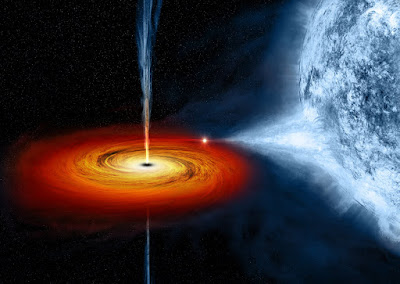
Black Holes are holes in space that absorbs anything in their way, even stars. They are made by a star exploding as supernova and the star must be about 3 times the mass of the sun. This is called the Oppenheimer-Volkoff limit.  Its core will collapse into a neutron star, but its gravity is so strong that it starts sucking in material from outer space and later turns into a black hole.  Once they absorb enough matter to become powerful and massive, they can start creating galaxies. That is why black holes can be found in the heart of galaxies.  Sometimes, black holes will emit the brightest light waves in the universe – quasars.  Now you might be asking, why don’t we see like “blink, blink” from earth? The answer is that they are very far. The furthest quasar from us is about 14 billion light years away. However, we are lucky to be on a planet that isn’t near a black hole. If we were near a black hole, we would get our atmosphere stripped first then ...