Posts

Light

Image
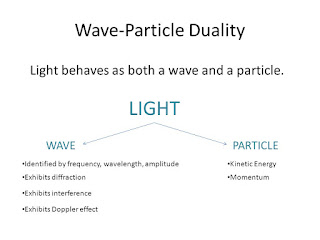
Light is an important part of our daily lives. Light is something that we humans definitely need. But a lot of us take it for granted, and only remember it in the middle of a science lesson. But what exactly is light? That is what I will explain today. I will explain about what is light, its speed, and some strange facts about light. First of all, if we want to know about light, we need to know what it actually is. Light is well known as a wave in the electromagnetic spectrum, but some people think that light is a particle. Nobody knows for sure. This causes the wave-particle duality of light. Light behaves as a wave, but in some ways also behaves as a particle. It’s sort of like the Schrodinger’s Box , where there is a cat that is both dead and alive. Does that ring a bell? For now, we’ll save that for another blog. Next, it’s speed. We all know what the speed of light is: 299,792,458 m/s. But let’s presume that we are in a car moving at 10% the speed of light. What woul...

Journey Around the Solar System Part 3

Image
Hello! Now I will share my knowledge about the rest of the solar system which is about the comets, asteroids, and much more! First of all, I will talk about the comets or in other words, shooting stars. The comets are big rocks made of ice and dust, which makes them some sort of dirty snowball. They hurtle through space at relatively high speeds. When a comet is close to the Sun, it moves much faster than when it is farther away from the Sun. Comets also have their own irregular orbit, which is usually oval-shaped. The most famous comet is the Halley’s comet, which makes an orbit around the Sun every 76 years. Comets mainly reside in the Kuiper Belt and Oort Cloud. The Kuiper Belt is a pack of dust, rocks, ice, and comets that orbit the Sun at 30-100 AU (Astronomical Unit), which is further from the Sun than Neptune. Just in case you don’t know, an Astronomical Unit or AU is a measure of length, which is the distance between the Earth and the Sun (150,000,000 kilometers). The O...

Journey Around the Solar System Part 2

Image
Hello! This is part 2 of the Solar System blog! (If you haven’t read part 1 yet, try reading that one first!) Today, I will be talking about the Jovian planets aka gas giants in our solar system! We begin with the fifth planet from the Sun, Jupiter. It’s the biggest planet in the solar system. Even though its mass is more than all of the other planets combined, it still only consists of less than 0.1% of all the mass in the solar system! Jupiter’s most famous feature is the Great Red Spot, a high-pressure hurricane region on Jupiter’s surface. It’s been occurring continuously since it was first spotted by Cassini in 1665. The Great Red Spot is as large as 3 Earths. Jupiter also has over a whopping 60 moons. The most famous are the Galilean Moons, which names are Ganymede, Io, Callisto and Europa. Ganymede is also the biggest moon in the solar system, being bigger than Mercury, having its own magnetic field and atmosphere. Io is a volcanically active moon, spewing out su...

Journey Around the Solar System

Image
You know about the solar system, don’t you? It belongs to our star, the Sun. The Sun's gravitational pull helps the planets have their orbit. Together, they form the solar system. I will be describing our Sun and planets. The Sun is our star. It gives our planet warmth and life for eons. Some cultures believe that the Sun is a god. It is around 1.5 million kilometers wide. Its surface temperature is around 6000°C but its core can reach temperatures of 15,000,000°C. One day the sun will explode into a white dwarf. When the sun‘s light is blocked out by the moon, it causes a solar eclipse. Plus, the Sun is the reason why there are seasons (along with the earth’s axis), equinoxes, and solstices. Coming up pretty small is Mercury. It is the smallest of the planets. Mercury has barely any gravity and a very thin atmosphere. However, it has scorching temperatures of 430 degrees Celsius and can suddenly drop to a teeth-chattering negative 180 degrees Celsius. It has a year...

Magnets

Image
When I was younger, sometimes I wonder how magnets work. I played with them a lot. Then I read a book about it and now I finally understand about the magnetic force and energy. I have decided to share this information with everyone. First, as everyone should know, magnets can attract magnetic things such as iron and steel, but not things like aluminum and plastic. Second, two magnets can attract each other as long as their poles are not the same. If they are the same, they will repel. Third, magnets don’t use magic. They use a magnetic field, which I will explain in the next paragraph. A magnetic field is a strong field around a magnet that attracts metallic objects or other magnets. A way to determine what your magnet’s magnetic field looks like is to sprinkle iron powder around the magnet and you should see that the pattern. This pattern is the same as the one in Earth’s magnetic field. There are three types of objects in terms of magnetic force. The first t...

The History of Earth

Image
In the beginning, about 4.6 billion years ago, our solar system did not exist. But then, the Sun formed from a collection of clouds of gas and dust in space. It later formed into a disc due to rapid rotation and gravity. At the center of rotation, the gas became dense and formed a baby star, our Sun! The leftover debris far away from the center formed the planets. One of them was Earth. It was just a big chunk of rock. More and more asteroids crashed into Earth, causing it to get bigger. It later turned into a sphere, and we went into the Precambrian Era , which was about 4.5 billion years ago. The carbon dioxide from the lava formed the atmosphere, and the water vapor in the atmosphere turned into clouds that brought rain that caused the seas to form. After the seas formed, the first microbe appeared. The microbes split to make more copies of them and evolved to get more complex and eventually turned into plants and animals. Cyanobacteria and algae helped our Earth to f...

Dwarf Planets

Image
Have you ever heard of Pluto? Not the Disney Character, Mickey’s dog, Pluto, nor the guy who was trying to beat up Popeye. That’s BLUTO. Or he is also called Brutus. So I am talking about the dwarf planet, Pluto. You might be thinking: “Hey, isn’t Pluto a Normal planet? And what on earth are dwarf planets?”Well, Pluto got demoted into a dwarf planet, which I will explain, and no, dwarf plants are not on earth. Dwarf planets are like mini-planets, but they have differences. First of all, most dwarf planets have strange orbits that are highly elliptical. They are very tiny as well. Unless you compare it with a human. Some still have moons like Pluto having the moon Charon (pronounced ‘sharon’), but others can have awkward shapes. Haumea, a dwarf planet in our solar system, is stretched to become like an egg! This is due to its rapid spinning. By the way, Eris is the biggest dwarf planet, not Pluto. Obviously, dwarf planets are in space, but not only in our solar system....